Supporting the Material Handling Sector
When a forklift drops pressure mid-shift or a dock leveller refuses to lift, the issue doesn’t stay contained to one machine. Loading bays back up, vehicles sit waiting, and dispatch schedules start slipping almost immediately.
That’s the reality of material handling. Hydraulic systems sit at the centre of daily operations, and when they fail, the impact is immediate across the entire site. It’s not just about replacing a hose; it’s about restoring movement, maintaining safety, and getting operations back under control.
At Hydraquip, this is what we deal with every day. Our engineers are called into live environments where downtime isn’t acceptable, and delays have a direct cost.
Why Hydraulic Systems Are Critical in Material Handling
Material handling relies on controlled, repeatable movement under load. Whether lifting pallets, positioning goods, or operating loading bay equipment, hydraulics deliver the force and control needed to keep operations moving safely.
In most environments, this equipment is running continuously. Forklifts cycle throughout shifts, dock levellers operate with every vehicle movement, and lifting platforms are used repeatedly across the day. That level of demand puts constant strain on hydraulic components, making reliability essential.
When a system fails, the impact is rarely isolated. We regularly attend sites where a single issue has halted an entire loading area. Vehicles are delayed, operators are forced to work around the problem, and pressure builds quickly across the operation. What appears to be a simple hydraulic fault can quickly escalate into a wider operational issue.
Common Hydraulic Components in Material Handling Equipment
Material handling systems are built around a combination of hoses, fittings, cylinders, and control components, all working under pressure and often in confined or high-wear environments.
Hydraulic hoses are one of the most common failure points. On forklifts and similar equipment, they are constantly flexing during lift and tilt cycles, often routed through tight assemblies where abrasion is unavoidable. Over time, this leads to external wear and internal fatigue, eventually resulting in failure under pressure.
Fittings are equally critical. BSP, JIC, and metric connections must be correctly specified and installed to maintain system integrity. A mismatch or poor connection will lead to leaks or pressure loss, and in many cases, repeat failures if not addressed properly. This is why Hydraquip engineers carry a wide range of hose types and fittings, allowing the correct specification to be matched on-site rather than relying on temporary solutions.
Beyond hoses and fittings, cylinders, pumps, and control valves drive the movement itself. When these components begin to wear, the signs are usually operational rather than visible. Lifting becomes slower, movement less consistent, and equipment begins to struggle under load. In many cases, what starts as a minor issue develops into a larger failure if not addressed early.
Fluid condition is another factor that is often overlooked. In material handling environments, particularly those with dust and debris, contamination can enter the system and accelerate internal wear. Poor fluid condition reduces efficiency and shortens component life, something we regularly identify during on-site inspections.
Common Hydraulic Failures in Material Handling Operations
The failure patterns in this sector are consistent. High cycle rates, constant movement, and demanding environments all contribute to predictable wear points.
Hose failures are one of the most frequent issues we attend. Forklift mast hoses, for example, are under continuous movement, and over time the outer layer wears through. When failure occurs, it is often sudden, leaving equipment immediately out of service. In these situations, rapid response is critical to minimise disruption.
Pressure loss is another common issue, often presenting as reduced lifting capability or slower operation. This is typically caused by internal wear within pumps or valves, or by leaks within the system. Left unresolved, it increases strain on the remaining components and raises the risk of a complete breakdown.
Leaks and seal degradation are also regularly seen on-site. Even minor leaks can lead to reduced efficiency and introduce safety risks, particularly in busy warehouse environments. Oil on the floor, reduced control in lifting systems, and ongoing fluid loss all create problems that extend beyond the initial fault.
How Hydraquip Supports Material Handling Operations
Material handling operations don’t stop, and hydraulic support needs to reflect that. Many of the sites we work on operate extended hours or around the clock, which means failures can occur at any time.
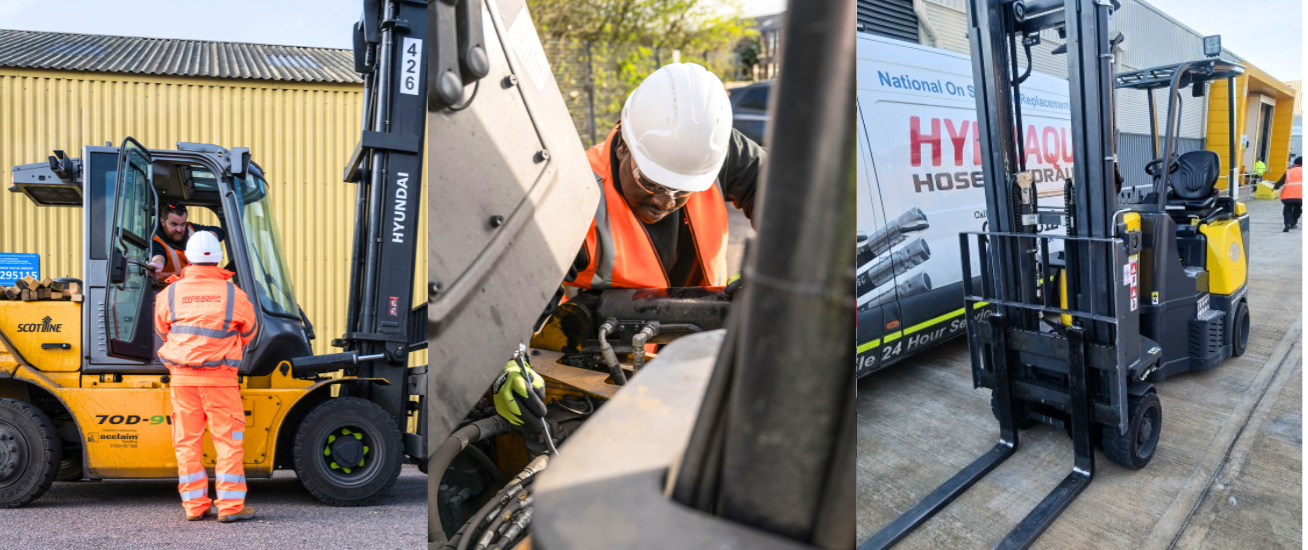
Hydraquip’s 24/7 mobile hose repair service is built around this reality. Our engineers attend site with fully equipped vehicles, allowing hoses to be manufactured and replaced on-site without the need to remove equipment. In most cases, the issue can be identified, resolved, and tested within a single visit, getting the machine back into operation quickly.
For businesses operating across multiple locations, consistency of service becomes just as important as speed. Hydraquip provides nationwide coverage, ensuring that whether the equipment is operating at a single warehouse or across multiple distribution centres, the same level of support is available.
Reducing downtime is always the priority. Our approach focuses on achieving a first-time fix wherever possible, supported by experienced engineers and well-stocked service vehicles. In high-throughput environments, this makes a direct difference to keeping operations moving.
Alongside this, Hydraquip’s Job Manager system provides full visibility of every call-out. Maintenance teams can log jobs, track progress, and access service records, giving greater control over reactive maintenance and helping to identify recurring issues across sites.
The ability to respond quickly, fix the issue correctly, and prevent repeat failures is what keeps operations moving. That’s where Hydraquip supports businesses across the UK and Northern Ireland, providing fast response, experienced engineers, and the infrastructure to resolve issues onsite.
Explore how our 24/7 mobile hydraulic service works, or book a call-out via Job Manager to keep your operation running.

