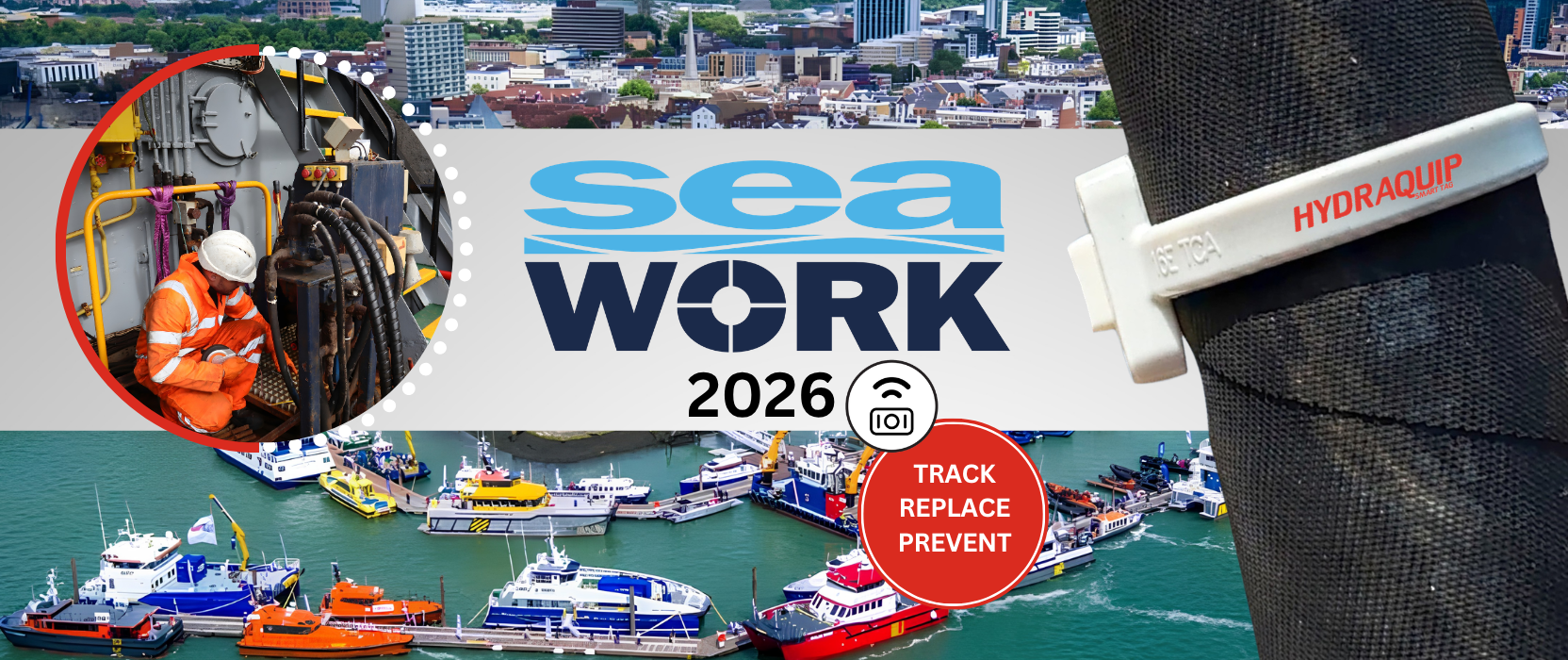
Visit Hydraquip at Seawork
If you work around marine hydraulics long enough, you start seeing the same issues appear again and again. Hose failures hidden behind panels nobody wants to remove. Equipment that’s been patched over three or four times because operations couldn’t stop long enough for a proper replacement. Asset records are sitting in folders somewhere ashore while the vessel is halfway through a job.
That’s really the sort of conversation Hydraquip will be having at Seawork from the 9-11th June 2026.
Marine operators are under pressure from every direction. Downtime costs. Compliance requirements. Tight turnaround schedules. Crews are trying to keep ageing equipment going without creating bigger problems later.
Marine hydraulics rarely fail at a convenient time
Hydraulic hose failures offshore or dockside never seem to happen when access is easy or when operations can simply pause for a few hours. Usually, it’s during loading operations, lifting work, dredging, or when a vessel’s already committed to a job window it can’t really miss. Marine environments are hard on hydraulic systems. Salt exposure, constant vibration, movement through articulated sections, fluctuating temperatures. It all adds up over time.
A hose assembly might look fine externally until you get closer and notice abrasion on one side where it’s been rubbing under movement for months. Or corrosion beginning around fittings because moisture’s been sitting there unnoticed.
That’s why preventative maintenance is so important, because unplanned downtime in marine work becomes expensive very quickly.
What Hydraquip will be focusing on at Stand U7
A big part of the discussion this year will centre around Smart Tag and asset visibility across hydraulic systems.
Smart Tag isn’t just about putting a tag on hoses
The system is about creating traceability across hydraulic assets so operators actually know what’s fitted, where it’s installed, when it was inspected, and what condition it’s in.
Each hose is fitted with an RFID tag linked back to a live asset register. Specification details, installation dates, inspection records, service history. It’s all tied together properly rather than spread across paper records, spreadsheets, or somebody’s memory. In marine environments, that matters more than people sometimes realise.
A vessel might have hose assemblies installed over several years by different contractors during different maintenance periods. After a while, nobody’s fully confident what’s original, what’s been replaced, or whether assemblies are approaching the end of their service life.
Inspection schedules become easier to manage properly
Rather than relying on somebody remembering when hoses were last checked, operators can track inspection intervals, monitor recurring issues, and identify assemblies that may need replacing before they become a problem operationally, often the warning signs are there.
Outer cover damage. Corrosion around ferrules. Heat exposure. Repeated flexing in the same location. Small leaks begin around fittings. Engineers see these patterns all the time during inspections.
Recurring failures. Improving maintenance processes. Managing ageing assets. Trying to reduce unnecessary downtime without overcomplicating systems.
The team will be discussing all of that at Stand U7, alongside how Hydraquip supports marine operators with hydraulic hose management, inspections, replacements, and broader hydraulic support.
See you there.

